
What Makes Up a Complete 96 V System with an ePropulsion Electric Motor?
The ePropulsion 96 V system is an advanced, modular solution designed for vessels requiring power and performance. Thanks to its flexibility, it can be adapted to various boat types – from sailboats to motor yachts.
In this article, we present in detail all key components of a complete 96 V system and explain why every element is essential for the proper operation of ePropulsion electric propulsion in this power class.

Most Important – the 96 V System is a Closed Ecosystem
The ePropulsion 96 V system based on the eSSA platform is a closed system – it must be built exclusively with dedicated manufacturer components. You cannot use substitute components, omit any required element, or connect additional consumers (lighting, pumps, refrigerators, inverters).
The 96 V system is exclusively for powering the electric propulsion and its original control electronics. [in accordance with ePropulsion eSSA Architecture guidelines]
Why the 96 V System?
The 96 V architecture offers a number of advantages compared to traditional 12 V or 48 V systems:
- Higher power with lower losses – higher voltage means lower currents at the same power, which reduces heat losses and allows for thinner cables
- Greater energy efficiency – fewer losses in energy transfer from batteries to motor
- Better scalability – easier integration with larger battery banks and more powerful motors (10–40 kW)
- Advanced eSSA monitoring – full system integration, real-time diagnostics, remote updates
Key Components of the 96 V System – Example with X40 Motor
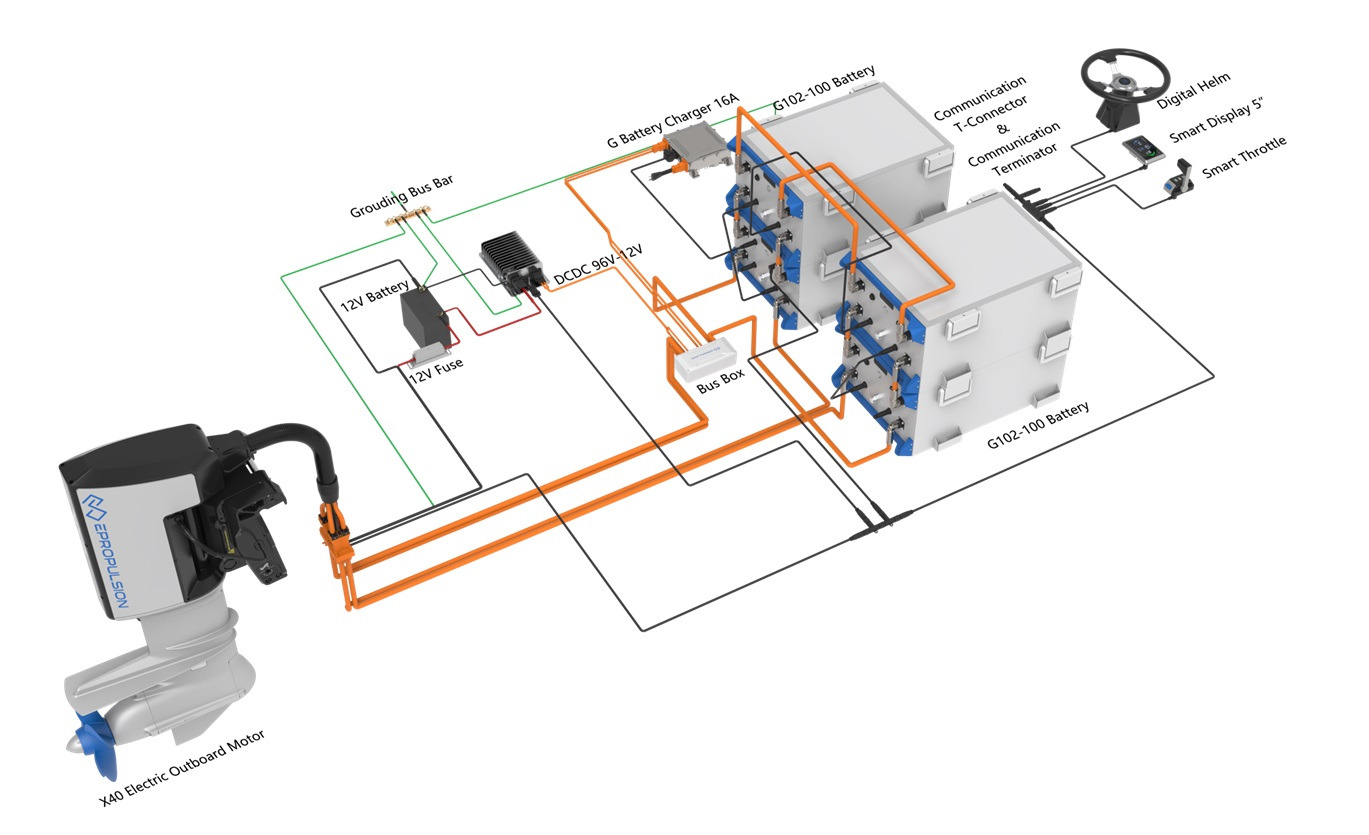
Below we discuss in detail the individual elements of a complete 96 V system using a configuration with the X40 outboard motor as an example. The installation diagram shown in the graphic displays the interconnections of all components.
1. Motor – Heart of the Propulsion
In the basic configuration of the 96 V system, the central element is the ePropulsion electric motor – outboard or inboard with power in the range of 10–40 kW.
Characteristics of 96 V Motors:
- 96 V outboard propulsion – ePropulsion X Series models (X12, X20, X40)
- 96 V inboard propulsion – ePropulsion I Series models (I10, I20, I40)
- Fully integrated construction with cooling system and eSSA communication
- Efficiency and real-time monitoring capability
- Hydrogeneration function (energy recovery while sailing)
Example: X40 is an electric outboard motor with 40 kW power (equivalent to ~54 HP), ideal for motor and sailing yachts 10–14 m in length.
2. Batteries – Energy Storage
To power a 96 V motor, the system requires appropriate batteries. In the proposed configuration for X40: four G102-100 batteries (10.24 kWh each) – this is the minimum for this motor.
G Series – LiFePO₄ 96 V Batteries:
- G102-100 – 96 V, 100 Ah, 10.24 kWh per module
- G102-230 – 96 V, 230 Ah, 23.04 kWh per module (option for larger systems)
- Lithium iron phosphate cells (LiFePO₄) – safe, durable, resistant to high charge cycles
- Integrated BMS (Battery Management System) – protection against overcharging, deep discharge, overheating
- CAN communication with other eSSA system elements
- Ability to connect multiple modules in parallel for increased capacity
Using four G102-100 modules provides a total capacity of 40.96 kWh, which ensures adequate energy reserve and operating time for the X40 model. View G Series Batteries
3. Control – Throttle and User Interfaces
Key to control comfort and work monitoring are dedicated control devices and displays.
Control Components:
- Smart Throttle – wired throttle compatible with X/I series, enables smooth power regulation, operating modes (ECO, SPORT), reverse
- Smart Display S2 – shows essential system data: battery state (SoC), instantaneous power, voltage, current, temperature, range, error history; integration with eSSA system
- Digital Helm (X Series only) – X series motors contain a built-in steering actuator, so no physical cable or hydraulic steering system is required. Control is via Digital Helm, which sends signals via EP-CAN to the actuator
Digital Helm eliminates the need for traditional steering cables or hydraulics – everything operates electronically with precision and low latency.
4. Battery Charger
To charge G102 batteries, a dedicated 96 V charger is required. The system package must include an ePropulsion compatible charger with voltage and characteristics matched to LiFePO₄ batteries to ensure fast and safe charging.
G Battery Charger 16A:
- Input: 100–240 V AC (50/60 Hz)
- Output: 96 V DC, 16 A
- Charging power: ~1.5 kW
- BMS communication – automatic adjustment of charging parameters
- Protection: against overcharging, short circuit, reverse polarity
5. DC-DC Converter (96 V → 12 V)
To power the system's onboard electronics and motor controllers (which operate at 12 V voltage), the 96 V system requires a DC-DC converter that converts high 96 V voltage to stable 12 V.
DC-DC Converter Functions:
- Conversion 96 V DC → 12 V DC
- Powers: display, throttle, digital helm, communication modules
- Protection: against overload, short circuit, overvoltage
- eSSA system integration – CAN communication, parameter monitoring
Important: The DC-DC converter must be original ePropulsion – using a substitute may disrupt system communication or damage electronics.
6. Communication and Cabling
A complete system requires dedicated cables and connectors that ensure safe transfer of energy and data between components.
Cable Types in 96 V System:
- Communication cables (EP-CAN) – enable connection of battery modules with motor, display and eSSA system; data cables, CAN bus protocol
- Battery connection cables (Bus Box cables) – connect G102 modules in proper parallel configuration, ensuring appropriate voltage and current; thick cross-sections, high-quality connectors
- High-voltage power cables (HV cables) – connect battery bank with motor; must withstand peak currents up to 400 A
- Grounding Bus Bar – grounding rail, provides common ground reference point for all system components
All cables must be original ePropulsion – they have appropriate cross-sections, insulation, connectors and certificates of compliance with marine standards.
7. Propeller – Outboard Motors Only
Selecting the right propeller is crucial for system efficiency – proper geometry and pitch ensure optimal conversion of motor torque to vessel movement.
How to Select a Propeller?
- Propeller diameter and pitch depend on: boat weight, hull shape, target speed
- For X40 motor: typically three-blade propellers, diameter 14–16", pitch 10–14"
- Too high pitch → motor overload, shorter range
- Too low pitch → insufficient RPM, low maximum speed
We recommend consulting with an authorized ePropulsion dealer to select the optimal propeller for your vessel.
8. (Optional) Additional Modules
The ePropulsion 96 V system allows integration of optional components that increase comfort and functionality:
GPS and 4G Antenna
Enable remote monitoring of system parameters (via ePropulsion app), integration with eSSA Cloud platform and over-the-air (OTA) firmware updates. Also allow geofencing and boat position tracking functions.
MPPT Solar Charger
If photovoltaic panels are installed on the boat, MPPT (Maximum Power Point Tracking) charge controllers can be added to the system, which will collect energy from panels and charge G102 batteries in passive mode during standstill or cruise.
These modules are not required for basic system operation, but significantly enhance user comfort and can extend vessel energy autonomy.
9. Why Build a 96 V System in This Configuration?
Maximum Power and Efficiency
The combination of 96 V motor with G batteries ensures high power, long range and stable operation in all conditions.
Scalability
The system can be expanded by adding more G modules or communication modules (GPS, 4G, MPPT).
Modern Monitoring
The eSSA platform and smart display provide full system control – you see all operating parameters in real time.
Reliability and Safety
BMS, solid cables, certified components and multi-level protection ensure safe operation for many seasons.
10. Important: ePropulsion 96 V System is a Closed System
The ePropulsion 96 V system based on the eSSA platform is a closed system, which means it must be built exclusively with dedicated manufacturer components.
For proper and safe operation, you cannot:
- Use substitute components from other manufacturers – batteries, chargers, converters, cables must be original ePropulsion
- Omit any of the elements required in the configuration – each component serves a specific role in eSSA architecture
- Connect any additional consumers to the 96 V installation (lighting, refrigerators, pumps, inverters, USB chargers, etc.)
The 96 V system serves exclusively to power the electric propulsion and its original control electronics. In eSSA systems, batteries from other manufacturers cannot be used – motors, BMS, chargers, cabling and communication are designed as an integral ecosystem. Changing one element or its absence causes loss of compatibility and can lead to failure or complete system shutdown.
11. Minimum Required Number of G102-100 Batteries (100 Ah / 10.24 kWh) for Individual Motors
Each ePropulsion 96 V motor model has specific minimum requirements for battery bank capacity. The table below presents official manufacturer recommendations:
| Motor Model | Power | Minimum Number of G102-100 Batteries | Minimum System Capacity | Typical Application |
|---|---|---|---|---|
| X12 / I10 | 10–15 kW | 1 battery | 10.24 kWh | Small sailing and motor yachts (6–9 m) |
| X20 / I20 | 20 kW | 2 batteries | 20.48 kWh | Medium sailing and motor yachts (8–12 m) |
| X40 / I40 | 40 kW | 4 batteries | 40.96 kWh | Large sailing and motor yachts (10–14 m) |
Note: The values given are minimum requirements for proper system operation. In practice, many installations use larger battery banks (e.g., 6–8 G102 modules for X40), which extends range and allows longer cruises without charging. It is also possible to use G102-230 modules (230 Ah, 23.04 kWh) for even greater capacity.
FAQ – Frequently Asked Questions about ePropulsion 96 V System
- 1 G102-100 battery (10.24 kWh) – approximately 7–8 hours (0–100%)
- 4 G102-100 batteries (40.96 kWh) – approximately 28–30 hours (0–100%)
In practice, charging from 20% to 80% (the so-called "sweet spot" for LiFePO₄) is faster and more beneficial for battery life – it takes about 60–70% of the above values. For faster charging, additional chargers working in parallel or solar panels with MPPT controller can be used.
- Economic speed (~4–5 knots, power 3–4 kW) – range ~40–50 Nm
- Comfortable speed (~6–7 knots, power 8–12 kW) – range ~20–30 Nm
- Maximum speed (~8–10 knots, power 30–40 kW) – range ~8–12 Nm
Additional G102 batteries or G102-230 modules (230 Ah) proportionally extend range. On sailing yachts, the hydrogeneration function allows energy recovery while sailing under sail, which additionally increases autonomy.
- Add more G102-100 or G102-230 battery modules (in parallel) – increases capacity and range
- Install additional GPS, 4G modules, MPPT controllers for solar panels
- Update motor, BMS and display firmware (OTA via ePropulsion app)
- Integrate the system with external navigation devices via NMEA 2000 protocol (optional)
Important: Every expansion must be performed using original ePropulsion components and in accordance with official installation guidelines. We recommend consulting with an authorized dealer.
- Real-time monitoring – all system parameters (SoC, voltage, current, power, temperature) are available on display and in mobile app
- Diagnostics and alerts – the system automatically detects problems and warns the user
- OTA updates – firmware can be updated remotely without service visit
- Modular integration – easy addition of new components (GPS, 4G, MPPT)
- Performance optimization – the system automatically manages battery discharge, protects against overload, balances modules
Summary
A complete ePropulsion 96 V system based on X40 or I40 motor and G102 batteries is a very efficient and scalable configuration for boat owners who need power, range and modern system integration.
Key system elements are:
- 96 V motor (outboard or inboard) – heart of propulsion
- G Series batteries (LiFePO₄, 96 V) – energy storage
- Control (Smart Throttle, Smart Display, Digital Helm) – user interface
- 96 V charger – for battery charging
- DC-DC converter – powering 12 V electronics
- Cabling and communication (CAN, HV, Bus Box) – system integration
- Propeller (for outboard motors) – performance optimization
- Optional modules (GPS, 4G, MPPT) – functionality expansion
Remember: The 96 V system is a closed system – all components must be original ePropulsion. You cannot use substitutes, connect additional consumers or omit required elements.
Planning to install an ePropulsion 96 V system on your boat?
We will help you select appropriate components, design cabling and plan integration tailored to your vessel.
View all ePropulsion motors and batteries
Contact us – our experts will gladly advise on selecting the optimal system for your boat.